Showing posts with label esl textbooks. Show all posts
Thursday, 15 October 2015
Business English: A Great Textbook for Telephoning In English
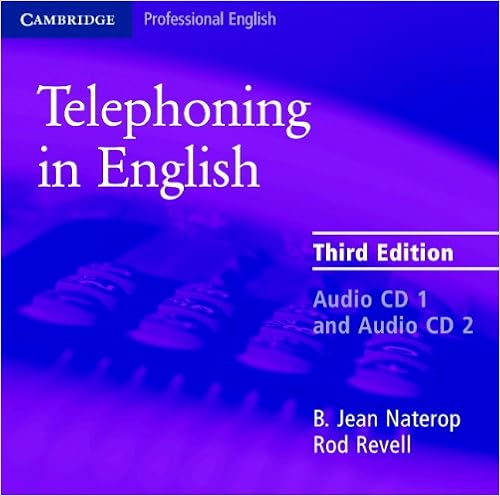
As always, there are many textbooks using the phone (smartphone, home phone, etc) in English. In my fifteen years of ESL teaching, "Telephoning in English" is the best for ESL learners who work in an international business.
There's a lot of non-native English speakers, so ESL learners get to listen to accented English. In business, you may often speak to people from Germany, Italy, France, and other non-English speaking countries. Telephoning In English will help you get used to different accents.
Telephoning In English is not easy. The speakers talk more naturally (fast), and, again, have strong accents. This is good because that's what you will hear in real business situations.
Telephoning In English covers taking messages, asking about late deliveries, and more. There's even a unit on ordering a pizza. So, you can practice different types of business telephone conversations.
Study Tip: If you're in an English speaking country, a good way to practice your telephone English skills is to order a pizza. The words you will need are very common (pepperoni is pepperoni in most countries), and it's excellent practice.
You can order Telephoning In English here.
Thursday, 1 October 2015
TOEIC: Preparation Textbooks & The Web
The Test of English for International Communication, better known as TOEIC is a very common test for those wishing to work or study in an international setting. In Japan, many companies have their employees take TOEIC at least once a year; the results can determine a worker's promotion prospects, job assignments, etc.
TOEIC has two parts: listening and reading.
Listening has four sections: photographs, question/response, short conversations, and short talks.
Reading has three sections: incomplete sentences, text completion, and reading comprehension.
The top score in TOEIC is 990.
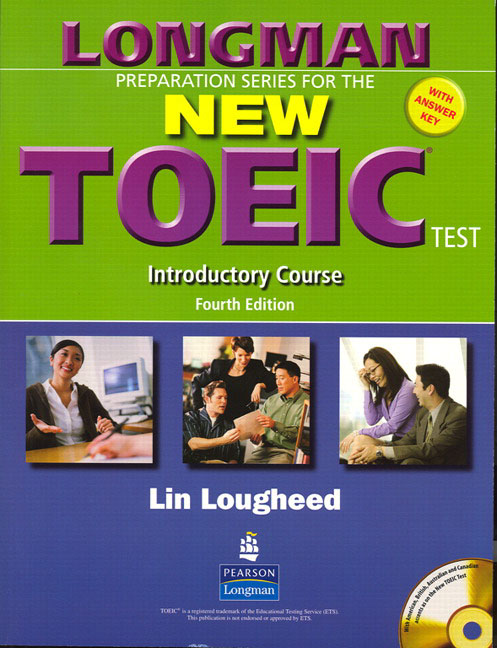
To prepare for the test, there are several texts you could use. However, in my experience, The Longman Preparation Series For The New TOEIC Test is the best of them.
There are texts available for people new to TOEIC, and people who have taken it before. The books cover all parts of the test, and provide strategies on each one. There is also a text of practice tests.
You can order the Longman TOEIC books on Amazon or find them (for free) at your local library.
The Internet has many, many sites that help to prepare students for TOEIC. The first is http://examenglish.com. It's free, but, it's not easy. All practice tests are the same as real test conditions. You can pause the tests if you need to, and replay questions.
YouTube is a great resource for English learners. I encourage ESL students to use it as much as possible, especially for listening, intonation, and pronunciation exercises.
The TOEIC test is very difficult. Native English speakers don't get perfect scores on it. Preparation and home study will help you complete the test, and improve your scores.
Next post will have techniques on how to do part one of TOEIC, pictures.
TOEIC has two parts: listening and reading.
Listening has four sections: photographs, question/response, short conversations, and short talks.
Reading has three sections: incomplete sentences, text completion, and reading comprehension.
The top score in TOEIC is 990.
905 - 990 International Proficiency
785 – 900 Working Proficiency Plus
605 – 780 Limited Working Proficiency
405 – 600 Elementary Proficiency Plus
255 – 400 Elementary Proficiency
185 – 250 Memorised Proficiency
10 – 180 No Useful Proficiency
To prepare for the test, there are several texts you could use. However, in my experience, The Longman Preparation Series For The New TOEIC Test is the best of them.
There are texts available for people new to TOEIC, and people who have taken it before. The books cover all parts of the test, and provide strategies on each one. There is also a text of practice tests.
You can order the Longman TOEIC books on Amazon or find them (for free) at your local library.
The Internet has many, many sites that help to prepare students for TOEIC. The first is http://examenglish.com. It's free, but, it's not easy. All practice tests are the same as real test conditions. You can pause the tests if you need to, and replay questions.
YouTube is a great resource for English learners. I encourage ESL students to use it as much as possible, especially for listening, intonation, and pronunciation exercises.
The TOEIC test is very difficult. Native English speakers don't get perfect scores on it. Preparation and home study will help you complete the test, and improve your scores.
Next post will have techniques on how to do part one of TOEIC, pictures.
Monday, 14 September 2015
" Whaddaya Say?" = What do you say?
If you'd like to work on both pronunciation, and listening for English at natural speed, "Whaddaya Say?" is a challenging, practical textbook. There is a listen and repeat section, listening questions, fill-in-the-blanks exercises, and conversation tasks in each unit.
The listening sections are not easy, but, you will be able to understand English when it is spoken naturally. "Whaddaya Say?" can be ordered here.
Subscribe to:
Posts (Atom)